


TFT is a variant of LCD. TFT is a kind of active matrix type liquid crystal display AM-LCD. TFT is equipped with a special light pipe on the back of the liquid crystal, which can "actively" control each independent pixel on the screen. It is the origin of the so-called Active Matrix TFT (AcTIve Matrix TFT), which can greatly increase the response time. Generally, the response time of TFT is relatively fast, about 80ms, while STN is 200ms. If you want to increase it, flicker will occur. And because the TFT is an active matrix LCD, the arrangement of the liquid crystal can be memorized, and will not return to the original state immediately after the current disappears. TFT also improves the STN flicker (water ripple)-mold lake phenomenon and effectively improves the ability to play dynamic pictures. Compared with STN, TFT has excellent color saturation, reduction ability and higher contrast, but the disadvantage is that it consumes more power and costs more.
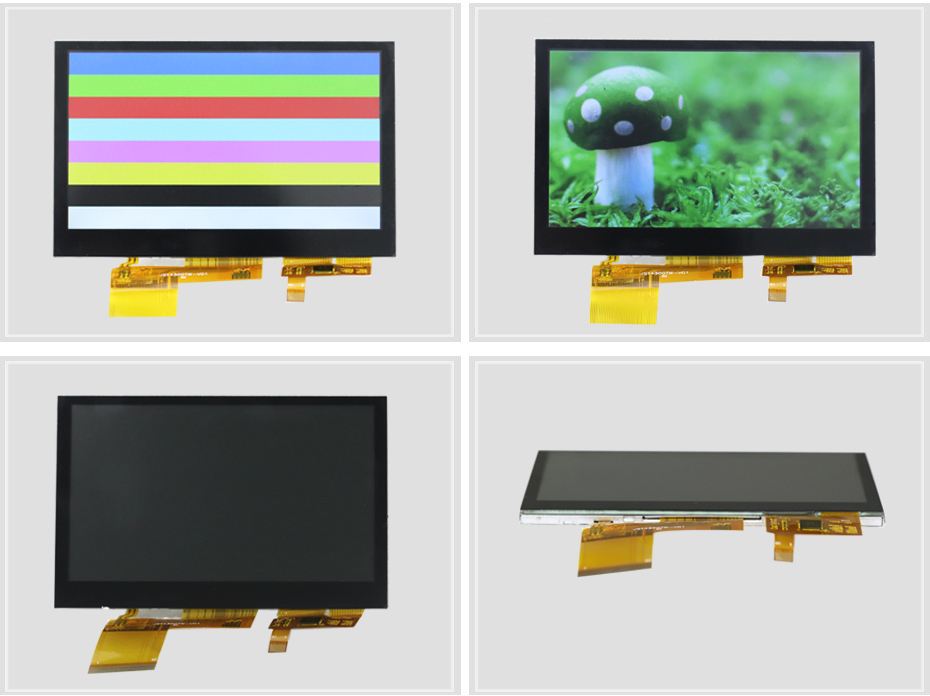
LCD: Liquid Crystal Display, liquid crystal display, mainly divided into: monochrome, pseudo color, true color and so on. And TFT is a kind of LCD, also called true color screen. The brightness and viewing angle are stronger than the other two!
LCD refers to liquid crystal display, TFT is a kind of LCD
Common liquid crystal displays are divided into four types according to their physical structure:
(1) Twisted Nematic (TN-Twisted NemaTlc);
(2) Super Twisted Nematic (STN-Super TN);
(3) Double Super Twisted Nematic (DSTN-Dual Scan Tortuosity Nomograph);
(4) Thin Film Transistor (TFT-Thin Film Transistor).
Among them, the basic display principles of TN-LCD, STN-LCD and DSYN-LCD are all the same, except that the twist angles of the liquid molecules are different. The twist angle of STN-LCD liquid molecules is 180 degrees or even 270 degrees. The TFT-LCD adopts a completely different display mode from the TN series LCD.
TFT-LCD technology is a skillful combination of microelectronics technology and liquid crystal display technology. People use the technology of microelectronics fine processing on si, transplant it to the processing of TFT array on large area glass, and then use the array substrate and another substrate with color filter film, using the mature LCD technology, A liquid crystal cell is formed and combined, and then after the process such as polarizing film sticking and other processes, the liquid crystal display (screen) is finally formed.
In TFT-LCD, the function of TFT is equivalent to a switch tube. The commonly used TFT is a three-terminal device. Generally, a semiconductor layer is made on a glass substrate, with source and drain connected to it at both ends. And through the grid insulating green film, opposite to the semiconductor, a grid is provided. The voltage applied to the gate is used to control the current between the source and drain electrodes.
For the display screen, each pixel can be simplified in structure as a layer of liquid crystal sandwiched between the pixel electrode and the common electrode. More importantly, it can be used as a capacitor from an electrical point of view. The equivalent circuit is shown in Figure 1. To charge the pixel P (i, j) in the j row and i column, the switch T (i, j) must be turned on to apply the target voltage to the signal line D (i). When the pixel electrode is fully charged, even if the switch is turned off, the charge in the capacitor is preserved, and the liquid crystal layer molecules between the electrodes continue to have a voltage application field. The function of the data (column) driver is to apply a target voltage to the signal line, and the function of the gate (row) driver is to turn on and off the switch. Since the display voltage applied to the liquid crystal layer can be stored in the storage capacitor of each pixel, the liquid crystal layer can work stably. This display voltage can also be rewritten in a short time through the TFT, so even in the high-definition LCD, it can meet the requirement of not degrading the image quality.
The key to displaying images is also the molecular orientation of the liquid crystal under the action of an electric field. Generally, different display modes are realized by aligning the inner side of the substrate to produce the desired structural deformation of the arrangement of the liquid crystal molecules. Select a certain display mode, under the action of an electric field, the orientation of the liquid molecules changes, and the intensity of the incident light after passing through the liquid crystal layer changes accordingly by matching with the polarizer. So as to realize the image display. All in all, TFT-LCD is different from the simple matrix of passive TN-LCD and STN-LCD. It is equipped with a thin film transistor (TFT) on each pixel of the liquid crystal display, which can effectively overcome the problem of non-gating. Crosstalk makes the static characteristics of the display LCD screen independent of the number of scanning lines, thus greatly improving the image quality. The characteristics of the switch unit (ie, TFT) must meet the requirements of low on-state resistance and very large off-state resistance.
LCD screen related information:
Which is better, LCD or OLED, and what is the difference?
How to maintain the LCD screen to have a long service life?
The working principle of LCD screen





