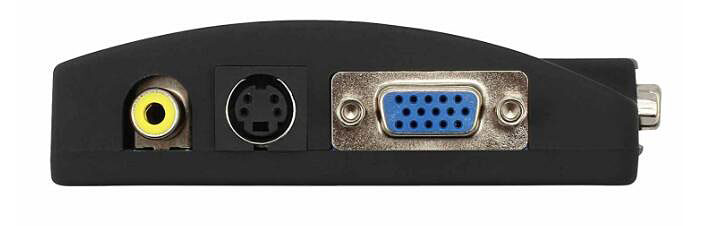

What are the signal input methods of TFT LCD screen? 1.VGA input
The VGA interface adopts asymmetrically distributed 15pin connection mode. Its working principle is to analog modulate the image (frame) signal stored in the digital format in the video memory into an analog high-frequency signal in the RAMDAC, and then output it to the projector for imaging. The VGA signal at the end (in the projector) does not need to be converted by a matrix decoding circuit like other video signals. From the previous video imaging principle, it can be seen that the video transmission process of VGA is the shortest, so the VGA interface has many advantages such as no crosstalk, no circuit synthesis and separation loss.

2. (DVI) digital video interface input
The DVI interface is mainly used to connect a computer graphics card with digital display and output functions to display the computer's RGB signal. DVIK (Digital Visual Interface) is a digital display interface standard formulated by the Digital Display Working Group (DDWG) on the Intel Developer Forum in September 1998. The DVI digital terminal has a better signal than the standard VGA terminal. The digital interface guarantees that all content is transmitted in digital format, guarantees the data integrity during the transmission from the host to the display (no interference signal is introduced), and a clearer image can be obtained.

3. (RCA) standard video signal input
Also called AV interface, usually a pair of white audio interface and yellow video interface, usually connected through RCA (commonly known as lotus head), only need to connect the standard AV cable to the corresponding interface of lotus head. The AV interface realizes the separate transmission of audio and video, avoiding the degradation of image quality caused by the interference of audio and video mixing. However, since the AV interface still transmits mixed luminance/chrominance (Y/C) video signals, the display device still needs to perform luminance/chrominance separation and chrominance decoding before imaging. This process of mixing and then separating will inevitably lead to the loss of color signals, and the chrominance signal and the luminance signal will have a great opportunity to interfere with each other, thereby affecting the final output image quality. AV also has a certain vitality, but due to its insurmountable shortcomings of Y/C mixing, it cannot be used in some situations where the visual limit is sought.

4. Video signal input signal
The full English name is independent video. In order to achieve better video effects, people began to explore faster, better, and higher-definition video transmission methods. This is also the heyday of S-Video (also called dual component video interface). The meaning of separate video is to transmit video signals separately. In other words, the chrominance signal C and the luminance signal Y are separated on the basis of the AV interface, and then transmitted in different channels. It appeared and developed in the late 1990s, and usually uses standard 4 cores (without sound effects) or extended 7 cores (with sound effects). Graphics cards and video equipment with S-Video interface (such as analog video capture/editing card TVs, quasi-professional monitoring TV cards/TV boxes and video projection equipment, etc.) have been widely used. Compared with the AV interface, since Y/C mixed transmission is no longer carried out, there is no need for bright color and color separation decoding. In addition, the use of independent transmission channels largely avoids image distortion caused by signal crosstalk in video equipment, and greatly improves image clarity. But S-Video still needs to mix two color difference signals (Cr Cb) into a chrominance signal C, which is decoded into Cb and Cr for processing after being transmitted in the display device. There will still be some signal loss and distortion (this kind of distortion is very small, but it can still be found under strict broadcast video equipment testing). And because of the mixing of Cr Cb, the bandwidth of the chrominance signal is also limited, so S-Video is far from perfect. Although it is not the best, it is still the most widely used considering the current market conditions and comprehensive cost. Video interface.