
The resistive touch screen uses pressure sensing for control. The main part is a resistive film screen that fits well with the surface of the display. This is a multi-layer composite film coated with a transparent metal oxide (TO) conductive layer and covered with a layer of outer surface hardening treatment, The smooth anti-scratch plastic layer (the inner surface is also coated with a layer of ITO coating), there are many small (about 1/1000 inch) transparent spacing points between them to isolate the two ITO conductive layers. When a finger touches the screen, the two conductive layers that are usually insulated from each other make a contact at the touch point. Because one conductive layer is connected to a 5V uniform voltage field in the Y-axis direction, the voltage of the detection layer changes from zero to zero. Non-zero, after the controller detects this connection, it performs A/D conversion, and compares the voltage value obtained with 5V to get the Y-axis coordinate of the touch point, and in the same way, the X-axis coordinate is obtained. The most basic principle common to all resistive technology touch screens.
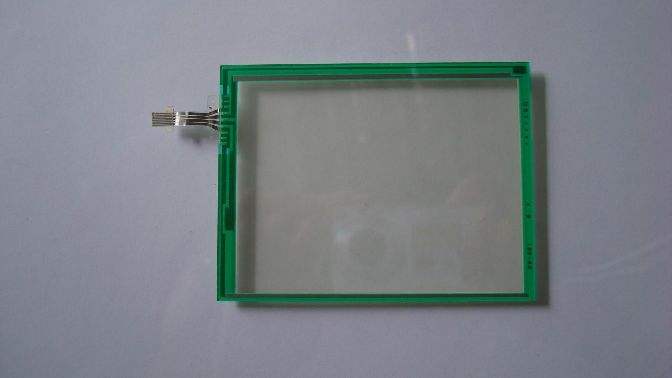
The key to resistive touch screens lies in material technology. Commonly used transparent conductive coating materials are:
ITO, oxide oxide, weak electrical conductor, the characteristic is that when the thickness drops below 1800 angstroms (angstroms = 10-10 meters), it will suddenly become transparent, the light transmittance is 80%, and the light transmittance will decrease when it becomes thinner. When the thickness reaches 30O angstroms, it rises to 80%. ITO is the main material used in all resistive technology touch screens and capacitive technology touch screens. In fact, the working surface of resistive and capacitive technology touch screens is ITO coating.
②Nickel-gold coating, the outer conductive layer of the five-wire resistive touch screen uses a nickel-gold coating material with good ductility. Due to frequent touch, the purpose of using a good ductile nickel-gold material is to prolong the service life. However, the process cost is relatively high. Although the nickel-gold conductive layer has good ductility, it can only be used as a transparent conductor. It is not suitable for the working surface of the resistive touch screen because of its high conductivity and the metal is not easy to be very uniform in thickness. It is not suitable for the voltage distribution layer and can only be used as a probe. Floor.
1. Five-wire resistive touch screen:
The base layer of the five-wire resistive technology touch screen adds the voltage fields in both directions to the conductive working surface of the glass through the precision resistance network. We can simply understand that the voltage fields in the two directions are applied on the same working surface in a time-sharing manner. The outer nickel-gold conductive layer is only used as a pure conductor, and the position of the touch point is measured by the method of time-sharing detection of the X and Y axis voltage values of the inner ITO contact point after touch. The five-wire resistive touch screen requires four leads on the inner layer of ITO, and only one conductor on the outer layer. There are 5 lead wires for the fusion screen.
Another proprietary technology of the five-wire resistive touch screen is to correct the linearity problem of the inner layer of ITO through a precise resistance network: the uneven thickness of the conductive coating may cause uneven voltage distribution.
Resistive screen performance characteristics:
①They are a kind of working environment completely isolated from the outside world, not afraid of dust, moisture and oil.
②It can be touched with any object, can be used for writing and drawing, which is their big advantage
③The accuracy of the resistive touch screen only depends on the accuracy of the A/D conversion, so it can easily reach 4096*4096. In comparison, the five-wire resistance is better than the four-wire resistance in ensuring the resolution accuracy, but the cost is high. Therefore, the price is very high.
Improvements to the five-wire resistive touch screen:
First of all, the A side of the five-wire resistive touch screen is made of conductive glass instead of a conductive coating layer. The process of conductive glass greatly improves the life of the A side and can increase the light transmittance.
Secondly, the five-wire resistive touch screen delegates the tasks of the working surface to the long-life A side, while the B side is only used as a conductor, and uses a nickel-gold transparent conductive layer with good ductility and low resistivity. Therefore, the B side Life expectancy is also greatly improved.
Another proprietary technology of the five-wire resistive touch screen is to correct the linearity problem of the A surface through a precision resistance network: due to the inevitable thickness unevenness of the process engineering, the voltage field is unevenly distributed, and the precision resistance network flows during operation. Exceed most of the current, so it can compensate the possible linear distortion of the working surface.
The five-wire resistive touch screen is currently the best resistive technology touch screen, which is most suitable for use in military, medical, and industrial control fields.
2. Four-wire resistive touch screen
The touch screen is attached to the surface of the display and used in conjunction with the display. If the coordinate position of the touch point on the screen can be measured, the toucher's intention can be obtained according to the display content or icons of the corresponding coordinate point on the display screen. Among them, resistive touch screens are used more in embedded systems. The resistive touch screen is a 4-layer transparent composite film screen. As shown in Figure 2, the bottom is a base layer made of glass or plexiglass, and the top is a plastic layer with a hardened surface that is smooth and scratch-resistant. The middle is There are two metal conductive layers on the base layer and the inner surface of the plastic layer. There are many small transparent isolation points between the two conductive layers to separate them. When the finger touches the screen, the two conductive layers touch at the touch point. The two metal conductive layers of the touch screen are the two working surfaces of the touch screen. A silver glue is coated on both ends of each working surface, which is called a pair of electrodes on the working surface. Voltage, a uniform and continuous parallel voltage distribution will be formed on the working surface. As shown in Figure 1, when a certain voltage is applied to the electrode pair in the X direction and no voltage is applied to the electrode pair in the Y direction, in the X parallel voltage field, the voltage value at the contact can be at Y+(or Y -) It is reflected on the electrode, and the X coordinate value of the contact can be obtained by measuring the voltage of the Y+ electrode to the ground. Similarly, when a voltage is applied to the Y electrode pair and no voltage is applied to the X electrode pair, the Y coordinate of the contact can be obtained by measuring the voltage of the X+ electrode.
Defects of four-wire resistive touch screen:
The B side of the resistive touch screen should be touched frequently. The B side of the four-wire resistive touch screen uses ITO. We know that ITO is an extremely thin oxide metal. During use, small cracks will quickly occur. Once the cracks occur, The current flowing through the place is forced to go around the crack, and the evenly distributed voltage is subsequently destroyed, and the touch screen is damaged, which shows that the cracks are not accurate. As the cracks intensify and increase, the touch screen will gradually fail, so the short service life is the main problem of the four-wire resistive touch screen